← Default view
TOP SECRET
— TOP SECRET // SERVE-OPS // EYES ONLY —

Deception, Disguise & Second-Contact Tricks

Field manual for amateur operatives. Four primary deception levers, the receiver's cue stack, the rules of engagement, and the operational sequence in which to deploy them. Compiled from 47 source assets.

File no.
SVR-46 / DECEP-PRIMARY
Subject
Club-level table tennis amateur
Mission
Win cheap points; set up the third-ball loop
Compiled
2026-04-30
Depth
EXPEDITION
Field assets
47 cited; ledger appended
TOP SECRET
FILE COPY · 1 OF 1
RECEIVED · 04-30-26
DO NOT DUPLICATE
From
Bureau of Spin Operations
To
The amateur, c/o the home club table
Re
Theatre of contact — what to hide, in what order
Classification
EYES-ONLY · NO RACKET-SIDE COVERAGE

Decision. Spin is locked at contact; everything before and after is theatre. Build deception from four levers, in this order: (1) a same-motion backspin/no-spin pair, sold by varying contact point on the blade[2][4]; (2) a semi-circular swing arc so contact happens at the bottom where the receiver cannot read direction[10][6]; (3) a deceptive post-contact wrist snap or arm flail to mis-sell the spin you actually put on[11][15]; (4) length disguise via first-bounce geometry on your side of the table — identical preparation across short, half-long, and fast-deep[26][24][30].

Once the four work, layer reverse-direction pairs as a Tier 2 operation. Against club opponents who haven't seen the motion before, even an unpolished reverse pays[34][36].

— Filed for the operative's reading. Standing recommendation: do not attempt to memorise; rehearse one lever at a time.

II. The Four Files FILE 01 · LEVERS ALPHA – DELTA

FILE 01-A
Lever Alpha Same-Motion Spin Pair
SECRET // ROI ★★★★★
Mechanism

One arm path. Vary one of three things at contact. Where on the blade you contact is dominant[2][17][19]: the tip travels fastest because it is furthest from the wrist pivot, so tip contact loads heavy backspin; contact near the handle — the (1,2)/(2,2) zone in EmRatThich's notation — produces a no-spin float, with the same swing and same wrist snap.

"For a forehand backspin serve, you would snap the wrist forward and contact the ball near the tip… For a no-spin serve, you would contact the ball near the handle… Same motion, same wrist snap, but now little spin."— Larry Hodges[2]

When in the arc you contact is the second lever. Lodziak: down-swing → backspin, up-swing → topspin, action looks the same to the opponent[1]. Rosario sharpens it: the bottom of a down-then-up swing — where direction reverses — is when the spin axis is hardest to read[6].

A last-instant bat-angle micro-tweak is the third[8]. Top players do all three at once and hide them inside subtle wrist differences rather than visibly different arms[5].

Receiver's failure mode

Pre-commits to push, pops the no-spin up[3].

First-pass cost

~2 weeks of focused serve practice. Single highest-ROI deception lever in the game.
CONFIDENTIAL
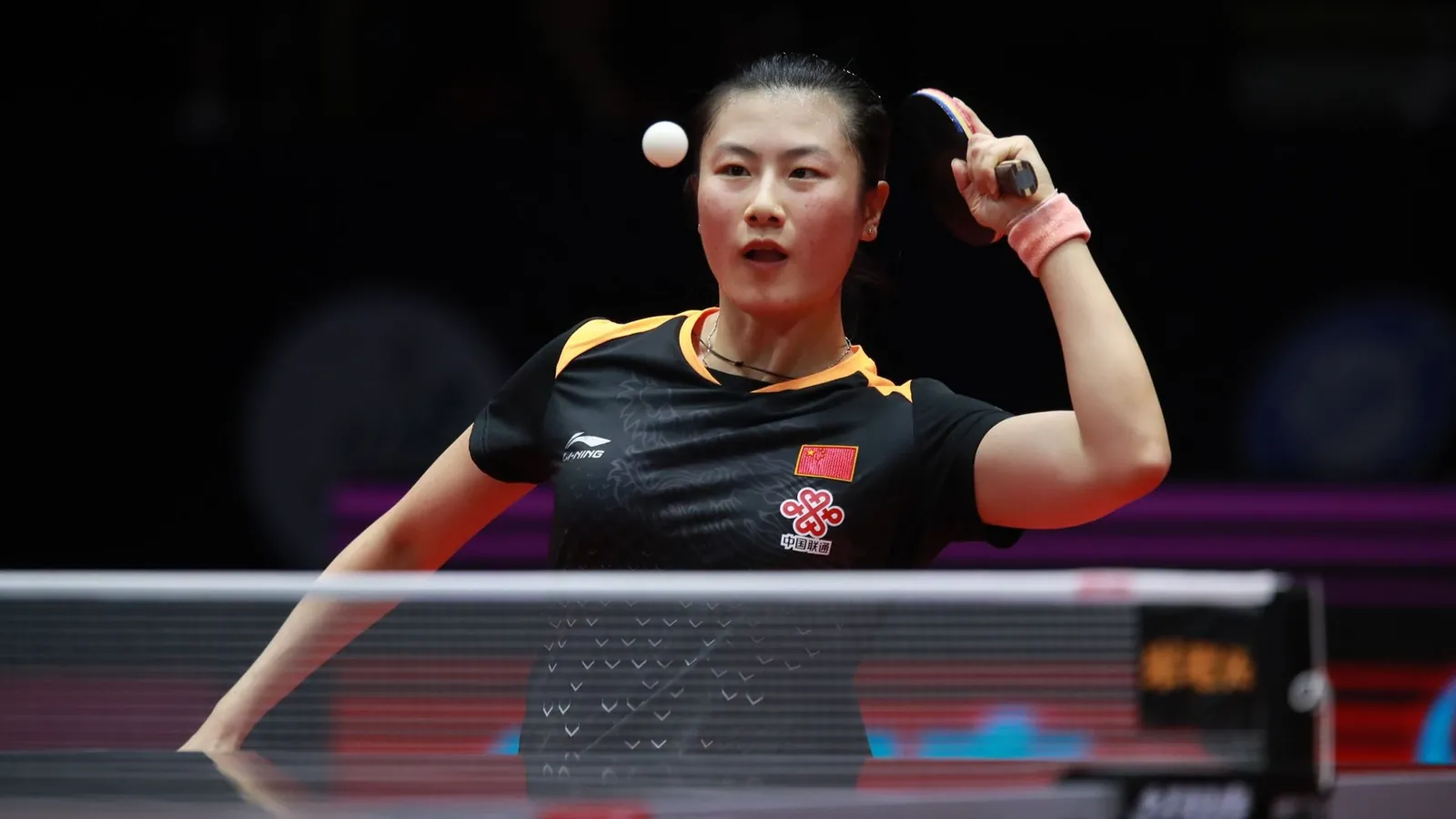
Asset photograph: subtle wrist differences in pendulum serving
EXHIBIT A-1Subtle wrist differences carry the spin variation. Source: ExpertTableTennis[5]
⚠ CompromiseDrooping racket tip leaks sidespin into a "pure" backspin and breaks the twin: the receiver now reads the lateral kick[7].
FILE 01-B
Lever Bravo Semi-Circular Swing Arc
SECRET // ROI ★★★★☆
Mechanism

A straight-line swing is read by anyone — the receiver takes Hodges' "mental flash photo" of the contact instant and reads bat direction directly[18]. The defeat is the semi-circular arc.

"If the racket goes through a semi-circular motion, your opponent has to figure out whether you contacted the ball on the downward, sideways, or upward part of the swing… If you move the racket quickly and smoothly through this semicircular motion, your opponent will have trouble picking up the exact point of contact."— Larry Hodges[10]

Coupled with a flexible wrist and high execution speed, the semi-circular path is what makes the same arm motion produce backspin, sidespin, no-spin, and topspin from the receiver's perspective indistinguishably[22][23]. Megaspin's analogy: "When the magician does the trick at his performance speed, it looks like magic"[23].

Kinematic backbone

A 2025 MDPI study found wrist angular velocity is the dominant predictor of both racket speed and ball speed across short and long serves; serve type differs mainly in wrist flexion-extension range and hand supination[21]. Translation: build the deception around a free wrist; your forearm should look the same.

First-pass cost

Bolted on top of Lever Alpha; low marginal cost.

FILE 01-C
Lever Charlie Post-Contact Theatre
SECRET // ROI ★★★☆☆
Mechanism

Spin is locked at contact. After that, only the receiver's read is in play. Two flavours.

"…dramatically flailing his arm in the opposite direction right after, which makes them anticipate the wrong direction of spin."— Adam Bobrow's signature, via Uberpong[15]

Theatrical follow-through. Brush one direction; flail the opposite way after contact[15]. Hodges describes the same trick in mirror: fake a grazing motion but actually pat the ball flat, then exaggerate the wrist snap after contact to mimic a heavy-spin serve[18].

During-contact fake. Jeff Plumb of PingSkills argues purely-after-contact fakes are too slow for the receiver's read window; you get more deception by moving the elbow in a different direction during the swing while the bat itself stays on path[12]. Mizutani's signature is a hybrid: same swing, different racket zone — receiver gets bounce and trajectory as their only reliable spin reads[11].

Operational note

The fake must be fast and timed to contact; visibly post-contact theatrics fail against good receivers[12]. Free if you exaggerate an existing follow-through; expensive only in match-test cycles.

CONFIDENTIAL
Asset photograph: Mizutani service action
EXHIBIT C-1Subject: Jun Mizutani. Different parts of the racket under near-identical swings. Source: Butterfly[11]
Cited assets [11] [12] [15] Bobrow [18]
⚠ CompromisePurely-after fakes don't fool advanced receivers. If the lever stops paying in match play, drop it for during-contact elbow misdirection[12].
FILE 01-D
Lever Delta Length Disguise via First Bounce
SECRET // ROI ★★★★☆
The geometry rule

Counter-intuitive: where the ball bounces on your own side controls length, and the relationship is mirrored across the net. Identical preparation, vary the first-bounce zone only.

Length goalFirst bounce on your sideHazard
Fast deepVery close to your end-line and corner; contact ball low, from a foot behind the table[26][25]Straying toward the net pops the ball up high after the second bounce
True shortClose to the net on both sides[27]; roughly halfway from end-line to net[24]Going too close to the net robs the ball of arc and dumps it in the net
Half-long (the trap)Such that second bounce lands within ~6 inches of receiver's end-line[29]Too long to push short cleanly; too short to loop comfortably[28]
Disguise comes from constancy

PingSkills: "The key is to have the same preparation for your serves and try to make the swing for your various spin and placement options as similar as possible. The less that changes the harder it is for your opponent to tell what serve you are doing"[30]. A high toss sells this further because most pros serve short; a hidden long fast serve from the same toss often wins the point outright[32].

The half-long trap, why it pays

A receiver who pushes a half-long serve has just told you they cannot loop your length cleanly — they'll pre-commit to looping the next one, which is when the genuinely short serve wins the point[28]. The pair only works if preparation is identical; if your half-long has a different motion, you lose the trap.

Recovery footwork is part of the disguise

Chinese coaching: serve → small jump → second small jump back to centre, all complete before the second bounce[33]. If your feet betray which serve you just hit, the spin disguise is wasted.

CONFIDENTIAL
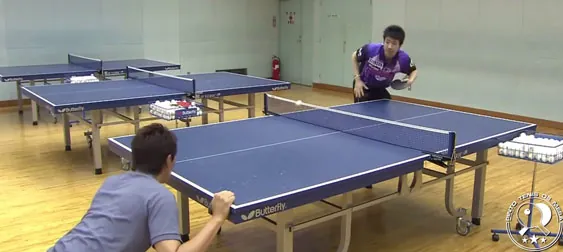
Asset photograph: short serve first-bounce geometry
EXHIBIT D-1First-bounce geometry for the short serve. Source: ExpertTableTennis[24]

III. Tier 2 Operations FILE 02 · DEFERRED · ADVANCED ASSETS ONLY

// LEVER ECHO · DIRECTION-REVERSAL PAIR

Reverse Pendulum & Reverse Tomahawk

Add this after Files 01-A through 01-D are working. Hodges' doctrine: once your forehand pendulum is grooved, develop the reverse pendulum; once your tomahawk is grooved, develop the reverse tomahawk; same for the backhand serve[34].

The disguise process matters as much as the spin. The reverse pendulum body action is the same wrist-back/release with matching waist and shoulder rotation, so the trunk shape an amateur receiver is keying on stays familiar[37]. Hodges adds the cognitive switching cost: opponents must readjust to your regular serves each time you alternate[35].

"I find I can read backhand serves much more easily than the Reverse Pendulum serve because I grew up returning backhand serves but nobody did Reverse serves when I played."— ALOIS ROSARIO, PINGSKILLS[36]

Sidespin curves the receiver's return in the opposite direction of the spin[39] — a pendulum/reverse-pendulum misread literally sends the ball off the side of the table. The tomahawk pair stacks an extra cost: each direction forces the receiver's wrist into the opposite ~45° contortion to return crosscourt[40].

Forum consensus: the payoff concentrates at beginner-to-intermediate level; advanced players counter the sidespin and the third-ball window closes[38] — which is exactly the club-player target.

CONFIDENTIAL
Asset photograph: tomahawk serve
EXHIBIT E-1Tomahawk serve. ~45° wrist contortion forced on the receiver. Source: ExpertTableTennis[40]
CONFIDENTIAL
Asset photograph: reverse serve
EXHIBIT E-2Reverse pendulum motion. Trunk shape preserved. Source: Butterfly[34]

IV. Asset Profile · The Receiver FILE 03 · CUE STACK / SURVEILLANCE LOG

// What the Subject Reads — Designate & Counter

OBSERVATION ROUND 1
CONFIDENTIAL
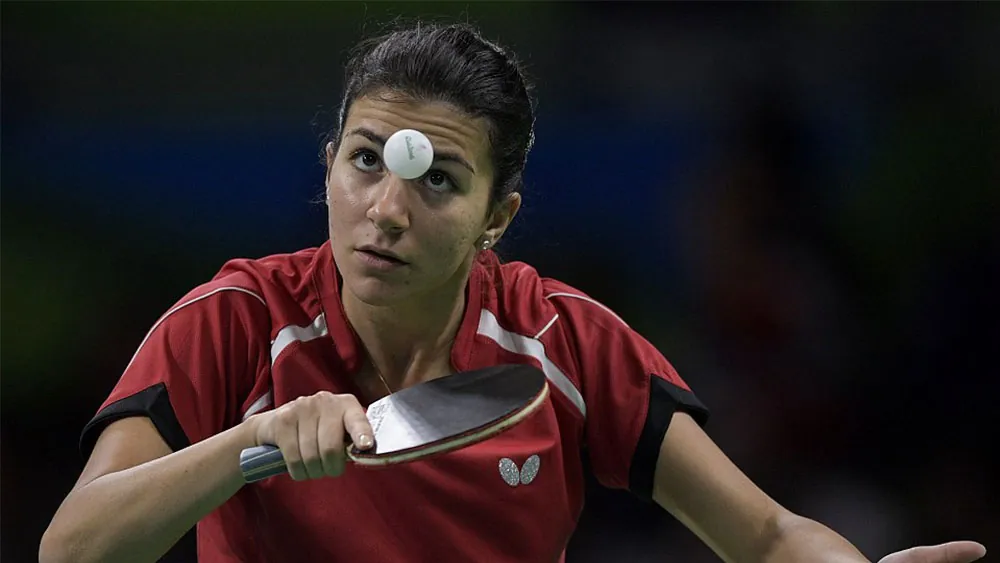
Asset photograph: receiver reading spin
EXHIBIT R-1Subject's read window: contact + flight. Source: ExpertTableTennis[46]
CONFIDENTIAL
Asset photograph: foot stomp on serve
EXHIBIT R-2Foot-stomp deployed to mask the audio tell. Source: RacketInsight[43]
Cue (what the asset uses)What it tells themCounter-measure (what you must hide)
Bat direction at contact (the "flash photo") Down → backspin · up → topspin · sideways → sidespin[41][18] Use a semi-circular arc so contact direction is ambiguous[10]
Racket speed minus ball speed Fast bat + slow ball ⇒ heavy spin; equal ⇒ no spin[42] Hide the speed differential by varying contact point on the blade, not arm speed[2][19]
Contact sound Grazed (spinny) is near-silent; flat (no-spin) makes a clear knock — ML classifiers can detect whether spin was applied from bounce audio alone[44] Stomp foot at contact to mask the audio tell[43]
Ball logo on the bounce Visible logo ⇒ no/light spin; blurred ⇒ heavy spin[45] Cannot be hidden — pair the heavy-spin and no-spin from the same motion so the logo cue arrives too late
Ball trajectory after bounce Backspin floats low and slow; topspin dips and kicks[45] Cannot be hidden — ball has left your blade. Make every other cue cost more by then
Follow-through Genuine info only if the rest of motion was honest; otherwise pure decoy[18][15] Decide: keep it short (mask) or fake it big (mis-sell). Never neutral
// DEEPER READ "if you asked a professional player point blank to explain to you the visual difference between a reverse pendulum serve with backspin and a reverse pendulum serve with topspin, they wouldn't be able to do it" — Ben Larcombe[46]. Reading is exposure-based pattern matching; deception that exploits unfamiliarity compounds[47].

V. Rules of Engagement FILE 04 · ITTF LEGAL FRAMEWORK

// THE RULES PENALISE INTENT, NOT CONTACT-COUNT
ActionVerdictJustification
Brush ball one way; flail arm opposite way after contactSingle contact + air motion is not a second strike[14][15]
Fake grazing, actually pat flat, exaggerate wrist snap afterSpin is set at the legal first contact[18]
Hide ball with free arm or body so receiver can't see contact✗ FOULLaw 2.6.4: ball must not be hidden from receiver[13]
Free arm still in front of ball-to-net space at contact✗ FOULLaw 2.6.5: free arm must clear once ball is projected[13]
Anything that prevents receiver seeing the racket-side used✗ FOUL2002 visibility rule — separates legal theatre from illegal hidden serve[16]
Deliberately strike ball twice during one stroke✗ FOULLaw 2.10.1.7 penalises intent specifically[14]

VI. Operational Sequence FILE 05 · 8-WEEK DRILL ITINERARY

Phase I · Weeks 1–2 Drill the same-motion backspin / no-spin pair Lever Alpha

Forehand pendulum. Blade-tip contact for backspin; near-handle for no-spin. No visible motion change. Test: have a partner call "backspin" or "no-spin" before they push — if they're guessing right >70%, you're not there yet[2][3][5].

Phase II · Weeks 2–4 Bolt on the semi-circular arc + foot-stomp acoustic mask BravoAudio

One continuous down-then-up swing, contact at the bottom, so the same pair becomes still harder to read[10][6]. Add the foot-stomp to mask the audio tell on the no-spin twin[43].

Phase III · Weeks 4–6 Add length disguise Delta

Keep toss height and arm preparation identical; vary first-bounce only. Drill short, half-long, and fast-deep from the same setup[24][26][28][30].

Phase IV · Weeks 6–8 Layer the post-contact fake Charlie

Deliberate big follow-through on the no-spin twin to mis-sell heavy backspin[15][18]. ⚠ Test in match play. If purely-after fakes stop paying, drop them for during-contact elbow misdirection[12].

Phase V · Months 2+ Tier 2 deployment: reverse-direction pair EchoDEFERRED

Reverse pendulum or reverse tomahawk. Fresh source of pressure — but only if the regular versions are already grooved[34][37][38].

VII. Known Compromises FILE 06 · OPSEC VIOLATIONS THAT KILL THE DECEPTION

Different arm motion per spin

Receiver reads bat direction directly; deception gone[18][30].

Fix: One motion, vary contact point and timing only.
Tip droops on backspin

Adds sidespin → breaks the spin/no-spin twin → receiver reads the lateral kick[7].

Fix: Keep the racket tip up; isolate wrist from arm.
Long, demonstrative follow-through on every serve

Receiver gets a bonus speed-amount cue[42].

Fix: Either short follow-through (mask) or theatrical opposite (decoy) — pick one per serve, not neutral.
Free arm lingering near ball at contact

Illegal under 2.6.5; lose the point before the rally[13].

Fix: Free arm clears the ball-to-net line as soon as ball is projected.
Different toss height for short vs long

Telegraphs length; receiver pre-commits[30][32].

Fix: One toss height — let first-bounce placement do the work.
Adding the reverse pendulum before the regular is grooved

Both look bad; neither generates pressure.

Fix: Sequencing: regular first → groove → reverse[34].
Stiff wrist

Disguise depends on wrist angular velocity at contact[21][23].

Fix: Index finger up the backhand rubber, free wrist; drill wrist-only first.
Footwork betrays the serve

If your feet betray which serve you just hit, the spin disguise is wasted[33].

Fix: Recovery complete before the second bounce — same pattern across all serves.

VIII. Related Dossiers SAME OPERATIONAL THEATRE

↰ Parent expedition · Killer serves for the amateur

IX. Field Reports APPENDIX · 47 SOURCE ASSETS

// Open complete intelligence ledger (47 reports)
[1]
tabletenniscoach.me.uk · Serve variation
Lodziak: identical pendulum action, contact while bat swings down → backspin; while rising → topspin.
Vendor blog
[2]
Larry Hodges · No-spin twin via contact point
Same swing, same wrist snap; tip → backspin, near handle → no-spin.
Vendor blog
[3]
Butterfly · Contact point on racket
Contact at base of paddle yields little spin; receiver mistakes no-spin for backspin and pops it up.
Vendor blog
[4]
Larry Hodges · Spin/no-spin pairs
Backspin/no-spin is the most popular twin: same motion, contact near handle for no-spin.
Vendor blog
[5]
ExpertTableTennis · Backspin on reverse pendulum
Top players hide spin pairs in subtle wrist differences; arm motion stays similar.
Vendor blog
[6]
PingSkills forum · Backspin on pendulum
Contact at the bottom of the down-then-up arc is hardest for the receiver to read.
Forum
[7]
PingSkills forum · Pure heavy backspin
Drooping racket tip leaks sidespin into a "pure" backspin and breaks the twin.
Forum
[8]
PingSkills forum · Reading no-spin vs backspin
Disguise lives at contact: chop-shaped arm path with near-flat bat angle = no-spin.
Forum
[9]
Human Kinetics · Mastering backspin serve
A deliberately abbreviated follow-through masks type and amount of spin.
Vendor blog
[10]
Larry Hodges · Semi-circular service motion
Semi-circular swing forces receiver to guess down/sideways/up at contact.
Vendor blog
[11]
Butterfly · Serving more deceptively
Mizutani uses different parts of the racket under near-identical swings.
Vendor blog
[12]
PingSkills forum · Fake motions on serves
During-contact elbow misdirection beats purely-after fakes against good receivers.
Forum
[13]
AllAboutTableTennis · Official rules
ITTF Laws 2.6.3-2.6.5: legal toss, ball not hidden, free arm clears.
Official
[14]
PingSkills forum · Double hit legal?
ITTF 2.10.1.7 penalises only DELIBERATE double strikes; air motion after one contact is fine.
Forum
[15]
Uberpong · Bobrow trick serve
Bobrow brushes one direction, then dramatically flails arm the opposite way.
Vendor blog
[16]
Megaspin · 2002 service visibility rule
Server must not prevent receiver seeing ball or racket-side used.
Official
[17]
PingSunday · Contact point for max spin
EmRatThich: (1,2)/(2,2) handle zone = no-spin; near head = max spin.
Vendor blog
[18]
Larry Hodges · Reading service spin
Receivers take a "mental flash photo"; servers fake grazing then pat flat.
Vendor blog
[19]
Megaspin · Advanced serving
Forearm accelerates to contact; where on paddle controls spin rate.
Vendor blog
[20]
Greg's TT pages · Spin on serves
Subtle changes to snap magnitude or direction → different spins from same-looking action.
Vendor blog
[21]
MDPI · Wrist kinematics in serves
Higher wrist angular velocity → higher racket and ball speed; serve type differs in flexion-extension and supination.
Peer-reviewed
[22]
Elevate Your Ping · Pendulum topspin
Pendulum-brush + flexible wrist builds deception across spin types.
Vendor blog
[23]
Megaspin · Serve like a pro
Flexible wrist + performance speed = magic-trick-style disguise.
Vendor blog
[24]
ExpertTableTennis · Keep serves short
Short serve: first bounce halfway between end-line and net or closer to net.
Vendor blog
[25]
ExpertTableTennis · Serve faster
Fast deep: first bounce near own end-line and corner.
Vendor blog
[26]
Larry Hodges · Fast deep serve
First bounce very close to own end-line, contact ball low from a foot behind table.
Vendor blog
[27]
Larry Hodges · Short serves
True short = bounces close to net on both sides.
Vendor blog
[28]
ExpertTableTennis · Half-long trap
Second bounce on/near receiver's end-line: too long to push short, too short to loop.
Vendor blog
[29]
Greg's TT pages · Double-bounce glossary
Half-long defined: second bounce within ~6 inches of receiver's end-line.
Wiki
[30]
PingSkills · Service disguise
Same preparation, similar swing across spin/placement options.
Vendor blog
[31]
PingSkills forum · Disguise short topspin
Strike just as bat starts upward; bounce close to body to mimic other serves' trajectory.
Forum
[32]
AllAboutTableTennis · Advanced serve
High toss disguises short vs long; hidden long-fast can win the point outright.
Vendor blog
[33]
PingSunday · Chinese footwork
Recovery: serve, small jump, second small jump back to centre, before second bounce.
Vendor blog
[34]
Butterfly · Reverse serves
Hodges: develop reverse versions once regular serves are grooved.
Vendor blog
[35]
Butterfly · Reverse-adverse results
Cognitive switching cost: opponent must readjust each time you alternate.
Vendor blog
[36]
PingSkills forum · Sense of reverse pendulum
Rosario: reads backhand serves easily but reverse pendulum is hard — exposure-driven.
Forum
[37]
TableTennisDaily Academy · Reverse pendulum 5 steps
Same wrist-back/release + matched waist/shoulder rotation; opposite sidespin.
Vendor blog
[38]
PingSkills forum · Reverse pendulum efficacy
Most disruptive at amateur/beginner level; advanced players counter the sidespin.
Forum
[39]
PingSunday · Return sidespin
Sidespin curves return in opposite direction of spin — misread sends it off the table.
Vendor blog
[40]
ExpertTableTennis · Tomahawk serve
Tomahawk forces receiver wrist into ~45° contortion to return crosscourt.
Vendor blog
[41]
Lodziak · Tips on reading service spin
Bat moving down at contact = backspin; up = topspin.
Vendor blog
[42]
Butterfly · Reading service spin
Hodges heuristic: racket speed − ball speed = ball spin.
Vendor blog
[43]
RacketInsight · Foot stomping
Foot stomp masks the audio tell distinguishing grazed (silent) from flat (knock) contact.
Vendor blog
[44]
arXiv 2409.11760 · Sound-based spin estimation
ML classifier reliably tells whether spin was applied from bounce sound alone.
Peer-reviewed
[45]
AllAboutTableTennis · Spin techniques
Logo visible on bouncing ball = little spin; blurred logo = heavy spin.
Vendor blog
[46]
ExpertTableTennis · Reading spin
Larcombe: even pros can't verbalize the visual difference; reading is exposure-based pattern matching.
Vendor blog
[47]
PingSkills forum · Reading spin/speed/placement
Rosario: two-channel input — contact and flight; exposure is the only fix.
Forum
FILE CLOSED FOR OPERATIONAL USE 04 · 30 · 2026
END OF FILE · DESTROY AFTER MEMORISATION · DO NOT TRANSCRIBE TO ASSET TABLES